If you've started looking past plastic and wood, you've probably hit the same fork in the road most home cooks do: stainless steel or titanium? Both promise the same thing — a cutting board that won't warp, won't stain, won't harbour bacteria, and will outlast everything else in your kitchen. But they don't behave the same way on the counter, on your knives, or on your bill.
This guide breaks down exactly how stainless steel and titanium cutting boards compare, answers the question almost everyone asks first ("will it dull my knives?"), and helps you pick the right one without overthinking it.
Quick verdict
If you want the short version:
- Stainless steel cutting boards are the better all-rounder for most kitchens — hygienic, durable, easy to clean, and far more affordable. A good one costs £25–£40.
- Titanium cutting boards are lighter and technically harder, but they're significantly more expensive (often 3–5× the price) and the real-world advantage over stainless steel is smaller than marketing suggests.
- Neither will destroy your knives if you use proper technique — but both are harder than your blade, so both require a slightly different approach than wood or plastic. More on that below.
For 9 out of 10 cooks, stainless steel is the right choice. Titanium only makes sense in very specific situations.
What is a stainless steel cutting board?
A stainless steel cutting board is a solid, non-porous board made from food-grade stainless steel — usually 304 or 316 grade. The surface is naturally antibacterial (stainless steel actively inhibits bacterial growth), dishwasher safe, and completely resistant to staining, warping, splintering, odours and cross-contamination.
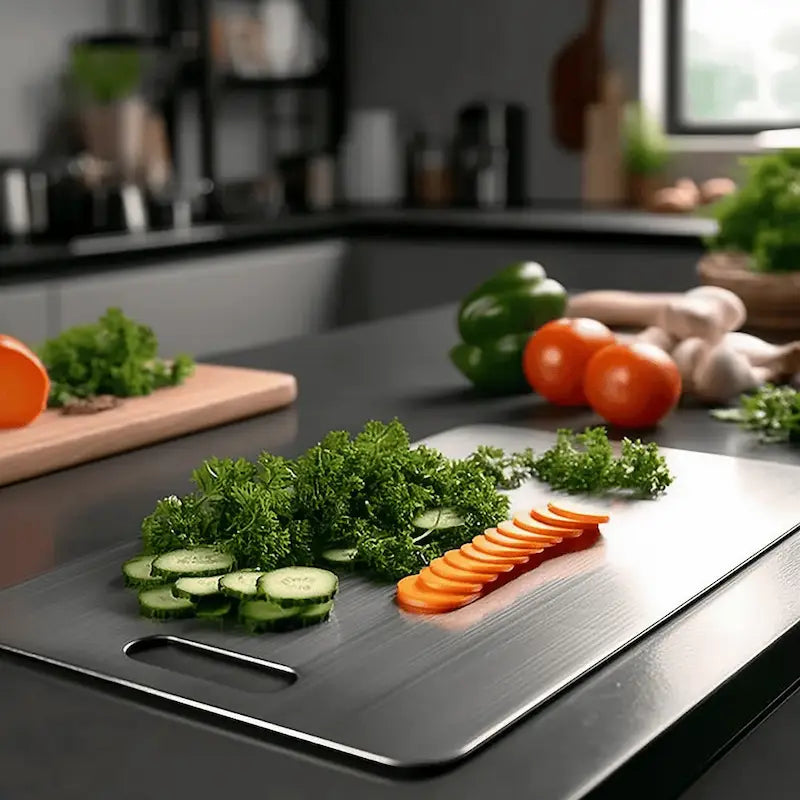
The good ones are thickened so they don't flex, and have a brushed or matte finish rather than a mirror polish, which stops food sliding around.
Typical strengths:
- Hygienic — no pores or knife grooves for bacteria to hide in
- Won't absorb smells (garlic, onion, fish)
- Dishwasher safe
- Won't warp, crack or split — will literally last decades
- Resistant to heat, so you can rest a hot pan on it
- Often doubles as a prep surface, serving board, or pastry surface (cold stainless is brilliant for dough)
Typical drawbacks:
- Heavier than plastic or wood
- Can be noisy if you chop aggressively (a silicone mat underneath fixes this)
- Harder than your knife, so blunt cuts will dull a knife faster than wood (technique matters)
What is a titanium cutting board?
A titanium cutting board is usually either a pure titanium sheet or — more commonly — a titanium-coated or titanium-alloy board. Titanium is famously corrosion-resistant, extremely hard, and very light.
On paper it sounds like the perfect board. In practice, the differences versus good stainless steel are small, and the price tag is not.
Typical strengths:
- Lighter than stainless steel (about 40% lighter by volume)
- Extremely corrosion resistant
- Non-porous and hygienic
- Won't stain or smell
Typical drawbacks:
- Expensive — often £80–£200+ for a board the same size as a £30 stainless steel one
- "Titanium-coated" boards can wear over time if the coating is thin
- Still harder than your knife edge, so the dulling question is identical to stainless steel
- Less availability, fewer sizes and shapes to choose from
Stainless steel vs titanium: head-to-head
Knife-friendliness
This is the question everyone asks, so let's settle it first.
Both stainless steel and titanium are harder than the edge of a kitchen knife. That means yes, both can dull a knife faster than a wooden or end-grain board if you use poor technique (chopping with force, "rocking" a heavy chef's knife like a cleaver, or scraping the blade sideways to push food).
But with correct technique — slicing cleanly, using the sharpness of the edge rather than pressure, and scraping food with the spine of the knife rather than the edge — the difference in knife life between stainless steel, titanium and wood is small. Professional kitchens have used stainless prep surfaces for decades without knives falling apart; they just sharpen more regularly.
Practical tip: if you're using a metal board, pair it with a quality whetstone and sharpen every 2–3 weeks rather than every 2–3 months. A sharp knife on a hard board is safer and performs better than a dull one on wood.
Winner: Tie. Both are harder than your blade. Technique matters far more than board choice.
Hygiene and food safety
Stainless steel is naturally antibacterial — studies have shown it actively inhibits bacterial growth on its surface, unlike plastic which develops micro-grooves that harbour bacteria, and unlike wood which can absorb moisture if not maintained. Titanium shares this property.
Both are completely non-porous, so neither will absorb juices, blood, or odours. Both can go in the dishwasher on a hot cycle.
Winner: Tie.
Durability
Stainless steel cutting boards — especially thickened commercial-grade ones — will outlast almost any other kitchen tool you own. They don't warp, crack, chip, or degrade over time. Titanium is slightly harder, but "slightly harder than something that already lasts 30+ years" isn't a meaningful advantage for most cooks.
Coated titanium boards are the exception — if the titanium is a coating over another metal rather than solid titanium, the coating can wear.
Winner: Stainless steel (edge on solid titanium, clear win over coated titanium).
Weight and handling
Titanium is about 40% lighter than stainless steel by volume. For a large board, that's the difference between ~2kg and ~1.2kg. If you're lifting the board often to tip ingredients into a pan, or you have wrist issues, this matters.
For most people it doesn't.
Winner: Titanium.
Price
This is where the comparison really breaks down.
- Good stainless steel cutting board: £25–£45
- Comparable titanium cutting board: £80–£250+
You can buy a stainless steel board, a whetstone to sharpen your knives, a silicone mat to dampen noise, and still spend less than the cheapest titanium board.
Winner: Stainless steel, by a mile.
Heat, stains and smells
Both are impervious to heat, won't stain from turmeric or tomato, and won't hold the smell of garlic, fish or onion. You can rest a hot pan on either. You can use either as a serving board.
Winner: Tie.
Summary table
| Feature | Stainless Steel | Titanium |
|---|---|---|
| Knife-friendly | With good technique | With good technique |
| Antibacterial | Yes (naturally) | Yes |
| Dishwasher safe | Yes | Yes |
| Won't stain / smell | Yes | Yes |
| Warping / cracking | Never | Never |
| Weight | Heavier | ~40% lighter |
| Heat resistant | Yes | Yes |
| Lifespan | Decades | Decades |
| Typical price | £25–£45 | £80–£250+ |
"Will a stainless steel cutting board dull my knives?"
Short answer: not meaningfully, if you use it correctly.
Here's what actually happens. Every cutting board — wood, plastic, bamboo, stainless, titanium, even glass — dulls your knife over time. Wood and end-grain boards are the gentlest because the fibres part and close around the blade. Plastic is similar but a bit harder. Stainless steel and titanium are harder than your edge, so the edge deforms faster if you use pressure.
Three things make stainless steel "dull your knives":
- Chopping with downward force. A knife should slice, not crush. If you chop hard enough to hear the blade hit the board, you're rolling the edge.
- Scraping food with the edge. Always use the spine (the blunt back of the blade) to scrape chopped food across the board.
- Not sharpening. If you use any cutting surface for months without maintenance, your knife will feel dull. A 5-minute pass on a quality whetstone every 2–3 weeks keeps the edge perfect, regardless of board material.
With those three fixes, a stainless steel board is no more punishing on your knives than a plastic one — and you get decades of hygienic, warp-free service in return.
Are stainless steel cutting boards actually good? The honest disadvantages
This is another query that comes up a lot, so let's be straight about the downsides.
Disadvantages of stainless steel cutting boards:
- They're louder than wood or plastic. Knife hitting metal has a sharper sound. A silicone mat or rubber feet fixes this.
- They're heavier. If you have grip or wrist issues, this is a real factor. Most boards come in at 1.5–2.5kg.
- They can feel colder. If you're rolling dough this is a feature; if you're setting out cheese, it's a drawback.
- They can dull knives faster without good technique (covered above).
- Cheap ones flex. A thin stainless steel board will feel tinny and move around. Buy a thickened one — it's the single biggest quality indicator.
Advantages that actually matter:
- Genuinely lifetime product — you will never replace it
- Easiest surface in the world to clean
- No bacteria, no smells, no stains
- Dual-purpose: prep surface, pastry board, serving board, hot pan rest
- A fraction of the price of titanium for 95% of the benefit
For most kitchens, the trade-offs land firmly in favour.
Who should choose which?
Choose stainless steel if:
- You want the best value and longest-lasting board on the market
- You cook regularly and want a hygienic prep surface
- You're happy to sharpen your knives on a normal schedule
- You like the idea of one board that handles meat, fish, veg, pastry and serving
Choose titanium if:
- You have a specific reason to prioritise weight (wrist issues, large board size)
- Price is genuinely not a factor
- You've already bought the best stainless steel option and want to upgrade
For the vast majority of home cooks — and plenty of professional kitchens — a thickened stainless steel cutting board is the smarter buy.
Our recommendation
If you've read this far, you're clearly serious about getting this right. Our Stainless Steel Antibacterial Cutting Board is the board we built around every point in this article:
- Thickened, commercial-grade 304 stainless steel — no flex, no tinny feel
- Naturally antibacterial surface, no coatings to wear off
- Brushed finish so food doesn't slide
- Works as a prep surface, pastry surface, serving board, and hot pan rest
- Backed by our 60-day returns and free UK delivery
Pair it with our Professional Dual-Sided Whetstone and you've got the complete knife-care setup — sharp blade, hygienic surface, lifetime quality — for less than the price of a single titanium board.
FAQ
Will a stainless steel cutting board ruin my expensive knives?
No — not if you use reasonable technique. Slice with the edge rather than chop with force, scrape food with the spine of the knife, and sharpen every 2–3 weeks with a whetstone. Professional kitchens have used stainless prep surfaces for decades.
Is titanium really better than stainless steel?
Marginally, in very specific ways (weight, hardness), but the real-world difference for a home cook is tiny and the price difference is huge. For 9 out of 10 kitchens, stainless steel is the better buy.
Can I put a stainless steel cutting board in the dishwasher?
Yes. Stainless steel is fully dishwasher safe and won't warp, stain or degrade from repeated cycles.
Do stainless steel cutting boards rust?
Good-quality food-grade stainless steel (304 or 316) will not rust under normal kitchen use. Avoid cheap boards that don't specify the steel grade.
Is stainless steel more hygienic than wood or plastic?
Yes. Stainless steel is naturally antibacterial, non-porous, and develops no knife grooves for bacteria to hide in. Plastic develops micro-grooves over time that harbour bacteria even after cleaning.
How do I stop my stainless steel cutting board from sliding?
Most thickened stainless steel boards come with rubber feet or a silicone backing. If yours doesn't, place a damp kitchen towel or a silicone baking mat underneath.
What's the best cutting board for a sharp knife?
End-grain wooden boards are technically the gentlest on an edge, but they need oiling and can harbour bacteria. Stainless steel gives you 95% of the knife-friendliness with 100% of the hygiene benefits and zero maintenance. Pair it with regular whetstone sharpening and you have the best practical setup for a sharp knife.
The bottom line
Titanium sounds exotic but delivers a marginal real-world upgrade at a big price premium. Stainless steel is the right answer for almost every kitchen — hygienic, near-indestructible, versatile, and a fraction of the cost.
Get a thickened stainless steel board, pair it with a proper whetstone, use good technique, and you've got a setup that will outlast every other tool in your kitchen.